Tatsuki Fujimoto had zero budget, zero expectations, and a story so unhinged his editor didn’t know what to do with it. When Fire Punch launched on Shōnen Jump+ in 2016 with little promotion, its first chapter quickly exploded on social media and even trended on Twitter, something editor Shuhei Hosono said he had never seen happen so fast in his 16 years at Shueisha. A frozen post-apocalyptic world, a man who can’t die, cults, cannibalism, and philosophical chaos that somehow works. Finding manga like Fire Punch is rare, but each pick on this list shares a bit of its DNA.
1. Chainsaw Man
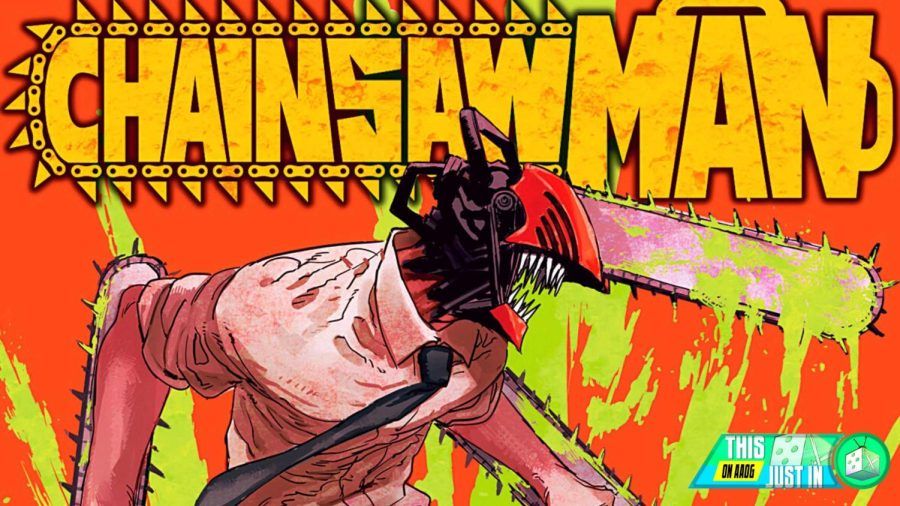
Starting here is basically mandatory. Chainsaw Man is the direct successor to Fire Punch, written by the same author, and every single thing Fujimoto learned from Fire Punch went straight into building this. The same unhinged energy, the same willingness to destroy characters you love without warning, and that same uncomfortable feeling of laughing at something deeply dark.
Denji is a broke teenager who merges with his devil dog Pochita and becomes a human-chainsaw hybrid to pay off his dead father’s debt. Where Fire Punch asks heavy questions about purpose and suffering, Chainsaw Man does the same thing while being somehow funnier and more unhinged at the same time. Over 35 million copies in circulation as of early 2026, a Reze Arc film that hit number one at the US box office in 2025, and a sequel anime arc already announced at Jump Festa, this manga is the easiest recommendation on this entire list.
2. Dorohedoro
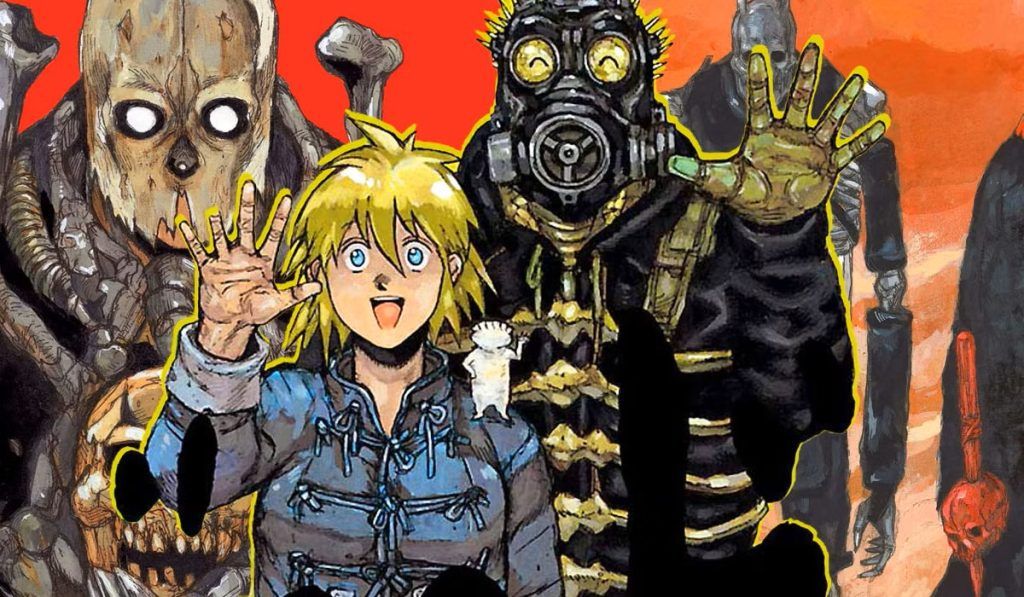
Q Hayashida spent 18 years drawing this entirely without assistants, which is almost unheard of in manga. The result is one of the most visually distinct and genuinely unhinged worlds in the medium, a grimy dystopia split between the poverty-stricken Hole, where humans live, and a stylish realm ruled by powerful sorcerers who use humans as test subjects for their magic.
The story follows Caiman, a man cursed with a lizard head and no memory of his past, and his friend Nikaido, who runs a gyoza restaurant. Together, they hunt the sorcerer responsible, biting suspects to reveal a mysterious face inside Caiman’s throat that judges each one. Dorohedoro carries many of the qualities that made Fire Punch memorable, including a bleak setting, morally complicated characters, and a strange mix of brutal violence and offbeat humor. The manga received an anime adaptation from MAPPA in 2020, and Season 2 is scheduled to premiere on April 1, 2026.
3. Berserk

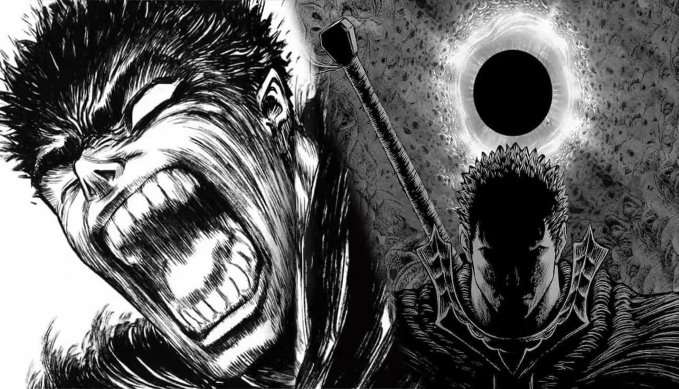
Kentaro Miura began publishing Berserk in 1989 when he was 22, and he spent more than three decades working on the series until his death in May 2021 at age 54. However, the manga later resumed in 2022 under the supervision of his close friend Kouji Mori with artwork by Miura’s assistants at Studio Gaga. With over 70 million copies in circulation worldwide as of 2025 and new volumes still debuting near the top of Japan’s Oricon charts, Berserk remains one of the most successful and enduring manga ever created.
Guts is a lone swordsman cursed with a brand that marks him for death, carrying a sword the size of a person through a brutal medieval world that never gives him a single break. The Fire Punch connection runs deep because the protagonist suffers endlessly and keeps moving anyway, the world is built to destroy its people, and the story somehow finds meaning inside all that darkness.
4. Tokyo Ghoul
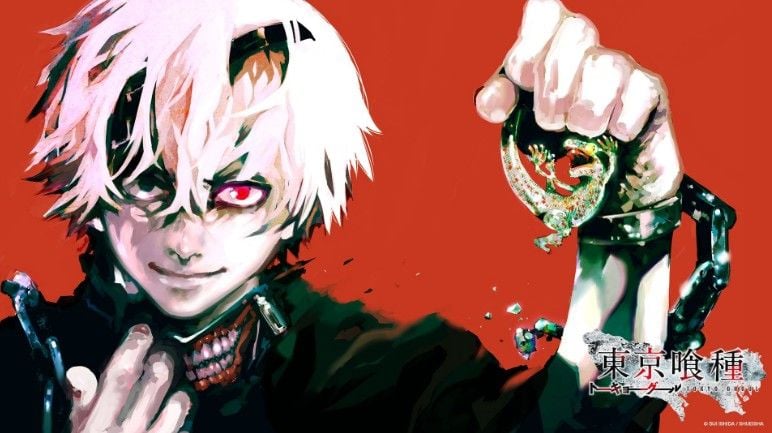
The first chapter of Tokyo Ghoul was published in 2011, while both the author and manga were still relatively unknown. Within a few years, it had grown into a major commercial success, eventually crossing 50 million copies worldwide. In this manga, a quiet college student gets attacked by a ghoul and wakes up as one.
Like Fire Punch, the horror comes from a protagonist who gets transformed into something monstrous against their will and has to keep surviving in a world with no good options left. The difference is that Fire Punch’s apocalypse is out in the open, brutal, and visible, while Tokyo Ghoul’s nightmare runs completely underground inside a city that looks totally normal on the surface. Having said that, just do yourself a favor and read the manga rather than following the anime past Season 1.
5. Akira
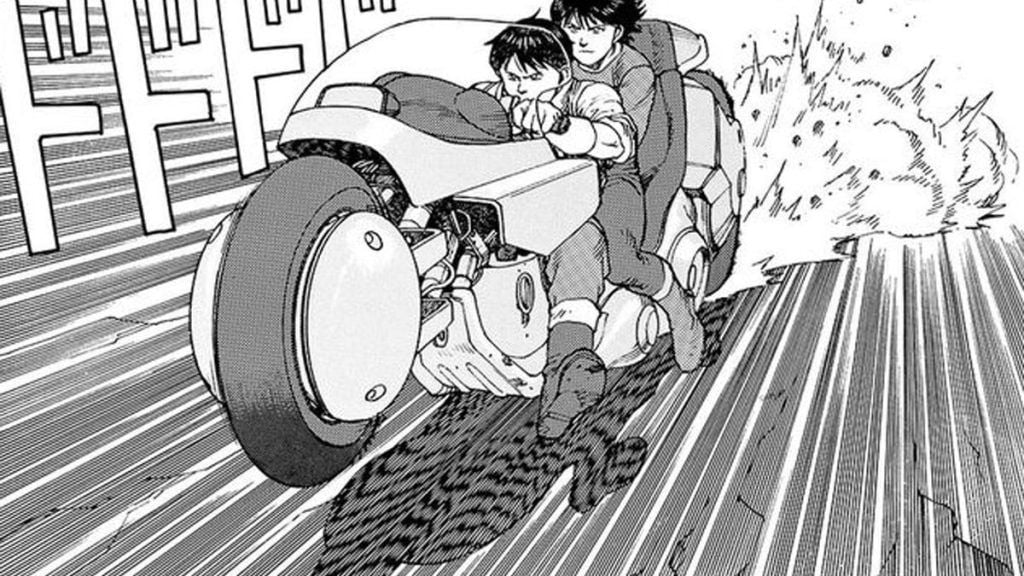
Before Naruto, before Dragon Ball went global, before anime was even a word most Western kids knew, there was Akira. Katsuhiro Otomo spent eight years and over 2,000 pages building a post-apocalyptic Neo-Tokyo crawling with biker gangs, government conspiracies, and psychic powers spiraling completely out of control. The Duffer Brothers credit it as a foundational influence on Stranger Things. Josh Trank cited it as the blueprint for Chronicle. It is, by most accounts, the manga that introduced the entire Western world to the medium.
Reading it after Fire Punch feels like finding the source code. The runaway power that destroys everything it touches, the government treating humans as experiments, and the world already broken before the story even begins. Otomo was doing all of this in 1982. At the 2019 Anime Expo, Katsuhiro announced that he was collaborating with Sunrise on a new Akira anime TV series, though as of 2026, no official release date or production updates have been confirmed.
6. Hell’s Paradise: Jigokuraku

Most people know Jujutsu Kaisen and Chainsaw Man as the two titans of the Dark Trio. Hell’s Paradise is the third one, and somehow still the most slept on of the three despite being just as good.
Yuji Kaku spent around two years as Fujimoto’s assistant on Fire Punch before writing this, and Fujimoto himself praised Sagiri, one of the main characters in the manga, and discussed Kaku’s design style. In Hell’s Pradise, a death row ninja gets offered freedom in exchange for retrieving an immortality elixir from an island south of Japan that nobody has ever returned from alive. The island turns out to be a living, breathing nightmare that slowly strips characters of their humanity the longer they stay. All in all, fans of Fire Punch will feel right at home in a world this beautifully hostile.
7. Ajin: Demi-Human
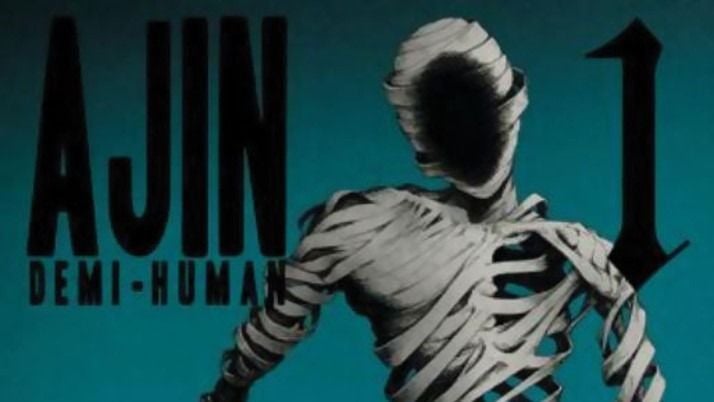
Getting hit by a truck and immediately standing back up is how Kei Nagai’s life falls apart. Turns out he’s an Ajin, one of a tiny number of functionally immortal humans, and the moment that goes public, the government wants him in a lab. Not to study him politely either. Think live weapons testing on a subject who keeps regenerating.
Gamon Sakurai ran this in Kodansha’s Good! Afternoon magazine from 2012 to 2021 across 17 volumes, and the immortality angle is where the Fire Punch parallel hits hardest. Both protagonists are trapped inside bodies that refuse to let them die, in worlds that see that as a resource rather than a miracle. The moral lines here are genuinely blurry too; you’re never fully sure who deserves to win, which makes the whole thing impossible to put down.
8. Takopi’s Original Sin
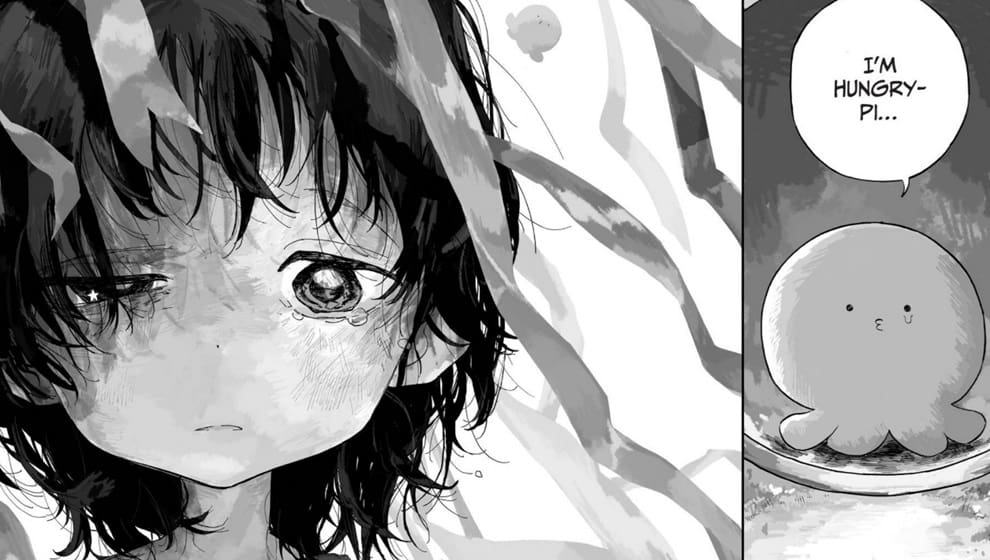
Takopi’s Original Sin cover looks like a cute children’s story about an alien octopus making friends. It is not. Takopi arrives on Earth to spread happiness and meets Shizuka, a fourth grader who gets bullied relentlessly and has nobody. What follows involves time loops, accidental murder, childhood trauma, and the cover art feels more and more like a cruel joke the further you read.
When the manga dropped on Shonen Jump+ in December 2021, it became the first title in the platform’s history to hit 2 million daily views, finishing its entire run in just 16 chapters across two volumes. There is no doubt that the Fire Punch fans will recognize that specific feeling of something unraveling faster than you can process it.
9. Girls’ Last Tour
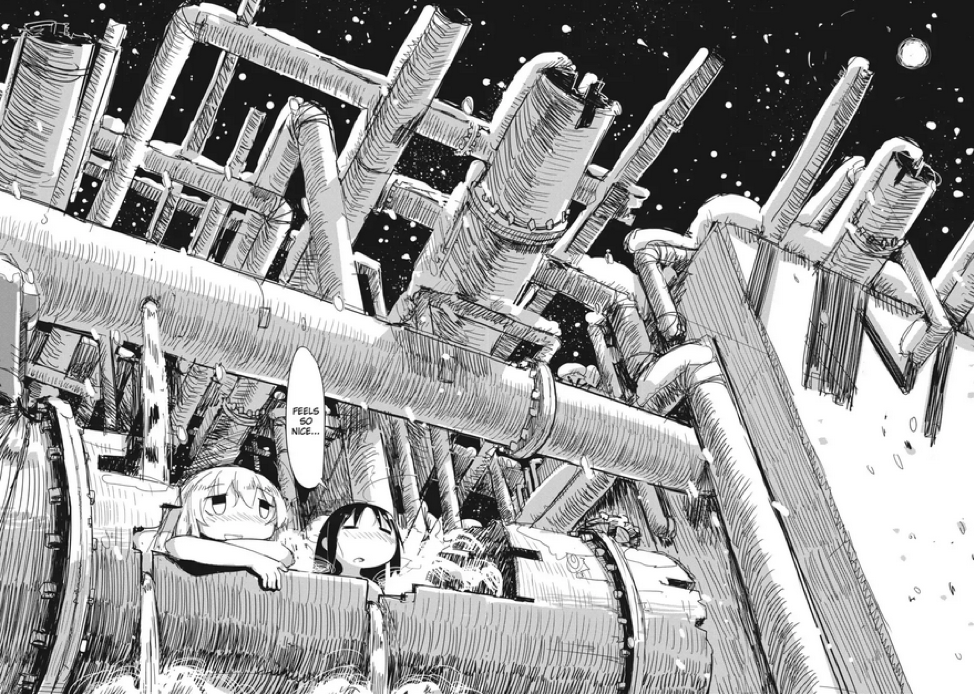
This one is the odd pick on the list, and deliberately so. Girls’ Last Tour doesn’t have any battles, power systems, or even villains to defeat. Just two girls on a military vehicle crawling through the ruins of a civilization that ended long before the story begins, looking for food, fuel, and water with no real destination in mind.
The Comics Journal called it the best longform narrative comic of the entire 2010s, which, for a six-volume manga serialized on a niche website, is a genuinely staggering claim. Surprisingly, Fire Punch and Girls’ Last Tour share the same starting point: a world that’s already over and a protagonist who keeps moving through it anyway. The difference is that Girls’ Last Tour strips away all the rage and replaces it with something way quieter.
10. Blame!
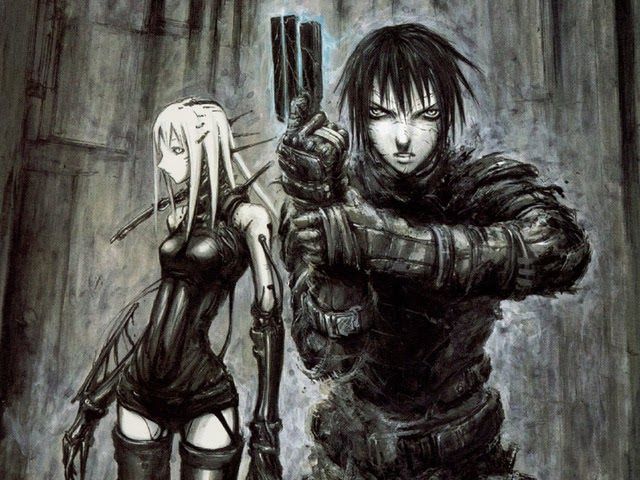
Tsutomu Nihei studied architecture before drawing manga, and it shows on every single page. The City in Blame! is a megastructure so enormous it has consumed most of the solar system, filled with haphazard architecture, hostile machine lifeforms, and scattered pockets of humans who have forgotten what land even looks like. Serialized in Monthly Afternoon from 1997 to 2003, it hit the underground manga scene like a storm and drew Marvel Comics’ attention, eventually leading Nihei to draw Wolverine and Halo comics for them.
Killy wanders through this collapsing world almost entirely alone and almost entirely silent, carrying a weapon powerful enough to punch through the megastructure itself. Reading it after Fire Punch feels natural because both stories share that same overwhelming sense of a world that has already lost, and a single figure moving through the wreckage anyway.
11. Gachiakuta
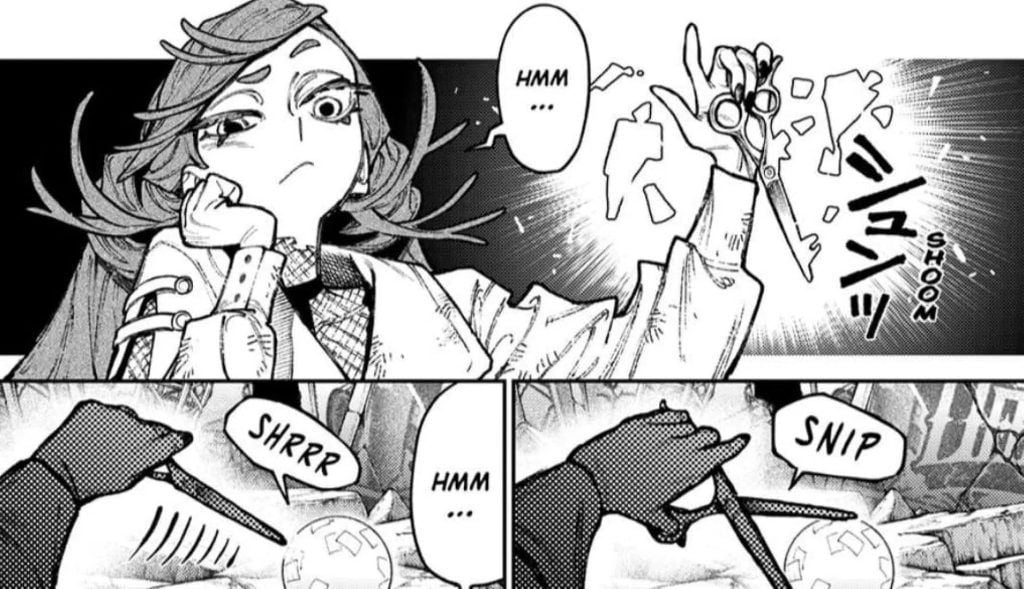
Critics are already calling it the next big shonen series, and after leading Crunchyroll’s popularity charts across the entirety of Fall 2025, it’s hard to argue. Kei Urana launched this on Weekly Shonen Magazine in February 2022 as her debut series, and the Soul Eater creator Atsushi Ohkubo personally named her his successor, which is about as strong an endorsement as you can get.
Rudo lives in the slums of a floating city where the wealthy discard everything they don’t want, including people, by throwing them into a bottomless pit called the Abyss. When he’s falsely accused of murder, that’s exactly where he ends up. The manga looks like street art come to life, and the story feels like Fire Punch in its tone, with a harsh world, a main character who keeps standing, and fights that have weight.
12. Land of the Lustrous
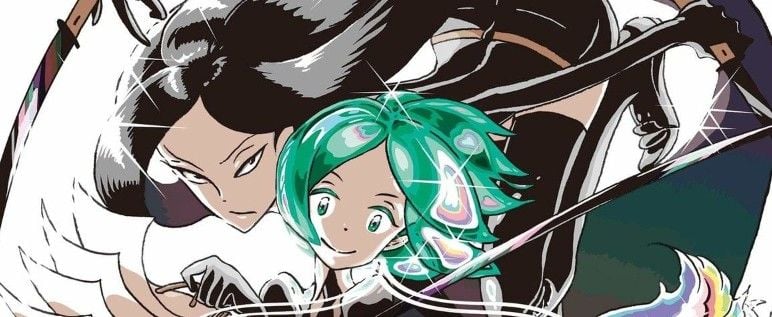
After six meteors hit Earth, humans are gone. What’s left is a single coastline populated by 28 immortal gemstone beings who shatter instead of die, and when they shatter, they lose the memories stored in their fragments. Haruko Ichikawa, who also designed characters for Pokémon Sun and Moon, spent 12 years building this world in Kodansha’s Monthly Afternoon magazine before completing it in April 2024.
The parallel to Fire Punch runs through the whole thing. There is an immortal protagonist slowly dismantled by a world that refuses to let them rest, losing pieces of themselves both literally and psychologically across the story. Both manga are also deeply philosophical about what survival actually costs. In 2025, Land of the Lustrous won the grand prize at the 45th Nihon SF Taisho Awards and the Seiun Award in the Best Comic category. Additionally, Studio Orange adapted it in 2017, but the manga goes significantly darker and deeper than the anime covers.