
If you’re watching anime or reading manga, you might come across words that are unfamiliar. While the list of anime terms could be almost endless and overwhelming, we’ve cherry-picked 50 core terms every fan should know to get started, covering fan culture, character types, genres, media, and common Japanese phrases.
Fan Culture Terms

OTP
OTP stands for One True Pairing, or, as fans joke, “OH THE PAIN!” Really, it’s the first one, but there’s not much difference between them. Generally, you pick two characters that you like and want them to be together, or “ship” them together. They become your OTP.
Canon
Canon is what the author and creator of the show has actually shown or written. Fans like to come up with head-canon all day, but they haven’t been confirmed by the creator. Usually, canon determines whether someone stays alive in a series or if a couple ends up together.
Weeaboo/Weeaboos
Weeaboos, known back in the day as Wapanese or “wannabe Japanese,” are anime fans who aren’t just in it for the anime. They’re in it for what they’ve decided is Japanese culture. They wear kimonos incorrectly, call everything “kawaii!” or “sugoi!”, and seem to think that Japanese cuisine consists exclusively of Pocky and ramen. They definitely want to move to Japan because it’s just like real-life anime, right?
Otaku
Originally meaning “venerable house” in Japanese, the term now refers to someone who is extremely devoted to a hobby or interest, often anime, manga, or games.
In Japan, calling someone an otaku can sometimes carry negative connotations, implying obsession or social awkwardness, though it’s not always insulting. Outside Japan, it’s commonly used simply to describe passionate anime or manga fans.
AMV
An anime music video (AMV) is typically a fan-made music video consisting of clips from one or more Japanese animated shows set to songs.
MAD
Similar to AMVs but originating from Japanese fan culture. MAD videos often use Japanese songs and can include fast-paced editing, parody, or tribute styles.
Doujinshi
Dōjinshi is the Japanese term for self-published works, usually manga or novels. They’re often the work of amateurs and can range from original stories to fan-made works featuring existing characters.
Subs vs Dubs
The eternal debate in anime fandom. “Subs” refers to watching anime in Japanese with subtitles, while “dubs” means watching with English voice actors. Fans have strong opinions on both sides.
Character Personality Types (Dere Types)
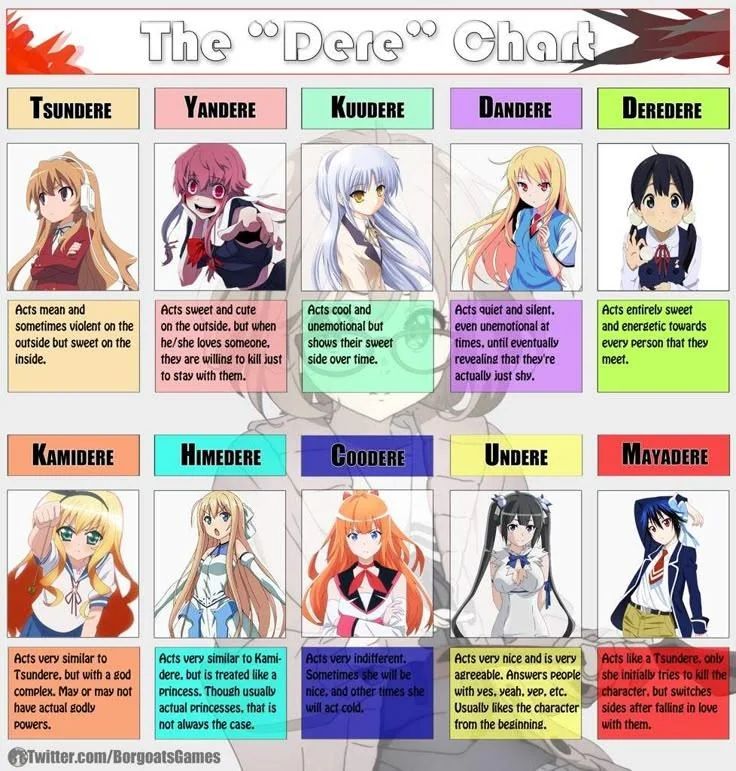
The dere family has many members, but we’ll cover the four core types that show up constantly in anime.
Tsundere
A tsundere is a Japanese term for a character development process that describes a person who is initially cold (and sometimes even hostile) before gradually showing a warmer, friendlier side over time.
Popular tsundere: Taiga Aisaka (Toradora!), Asuka Langley Soryu (Neon Genesis Evangelion), Chitoge Kirisaki (Nisekoi)
Yandere
A yandere is defined as someone who appears sweet and loving on the surface but becomes dangerously obsessive, possessive, and potentially violent when it comes to their love interest.
Popular yandere: Yuno Gasai (Future Diary), Himiko Toga (My Hero Academia), Kotonoha Katsura (School Days)
Kuudere
A kuudere is a character who appears cold, emotionless, and distant on the outside but has a warm, caring side that they rarely show. Unlike tsunderes who are hostile, kuuderes are simply aloof and expressionless.
Popular kuudere: Rei Ayanami (Neon Genesis Evangelion), Nagato Yuki (The Melancholy of Haruhi Suzumiya), Takashi “Mori” Morinozuka (Ouran High School Host Club)
Dandere
A dandere is a quiet, shy character who struggles with social interaction but becomes talkative and sweet around people they’re comfortable with, especially their love interest.
Popular dandere: Hinata Hyuga (Naruto), Chiyo Sakura (Gekkan Shoujo Nozaki‑kun), Rinko Yamato (Ore Monogatari!!)
Anime & Manga Genres

Shōnen
A genre of Japanese comics and animated films aimed primarily at a young male audience, typically characterized by action-filled plots.
You’ve probably heard of popular series like Naruto, One Piece, and Dragon Ball.
Shōjo
A genre of Japanese comics and animated films aimed primarily at a young female audience, typically characterized by romance and relationship-focused plots.
You’ll find this in anime like Fruits Basket, Kaichou wa Maid-sama!, and Ouran High School Host Club.
Seinen
A genre aimed at adult men, typically featuring more mature themes, complex plots, and realistic violence.
Well-known examples are One Punch Man and Tokyo Ghoul.
Josei
A genre aimed at adult women, featuring realistic romance and slice-of-life stories with mature themes.
For example, Usagi Drop and Chihayafuru are quintessential josei shows.
Isekai
A genre where the protagonist is transported to, reborn, or trapped in a parallel universe or fantasy world. Literally means “different world” in Japanese. Popular examples include Sword Art Online and Re:Zero.
Slice of Life
A genre focusing on everyday experiences and mundane aspects of life, often with minimal plot. These shows emphasize character development and atmosphere over action.
Think K-On!, Barakamon, and Laid-Back Camp for perfect representations of this genre.
Yaoi
Yaoi, also known as Boys’ Love (BL), is a narrative featuring a romance or relationship between two or more males, like in Given or Junjou Romantica.
Yuri
A narrative or visual work featuring a romance or relationship between two or more females.
Examples include Citrus and Bloom Into You.
Ecchi
Ecchi is an often-used slang term in the Japanese language for playfully sexual actions. As an adjective, it’s used with the meaning of “sexy,” “dirty,” or “naughty.” Ecchi anime contains suggestive content but stops short of explicit scenes.
Notable examples are High School DxD, Mushoku Tensei, and Prison School.
Content & Media Types
OVA
Short for Original Video Animation. OVAs often contain special extra episodes marketed to fans who may have seen an entire series but are hungry for more. They’re released directly to home video rather than airing on TV.
ONA
Short for Original Net Animation. Similar to OVAs but released exclusively online through streaming platforms rather than physical media.
Special / OVA Special
Standalone or bonus episodes released outside the regular TV broadcast. These are often holiday episodes, fan-service specials, or extras bundled with Blu-rays or manga volumes.
Omake
A Japanese word meaning “extra” or “bonus.” It refers to short bonus scenes, comedic skits, or extra content included at the end of an anime episode, Blu-ray, or DVD.
Many popular shows like One Piece, My Hero Academia, and Attack on Titan include omake segments for fans.
Manga
Japanese comic books that serve as the source material for many anime series. Fans often compare the anime to the manga to see what was changed, cut, or expanded.
Light Novel (LN)
A format of short, illustrated novels aimed at young adults. Many popular anime, especially isekai and fantasy series, originate as light novels.
Famous examples include Sword Art Online, Re:Zero − Starting Life in Another World, The Rising of the Shield Hero, Overlord, and Konosuba, all of which have become staples of modern anime culture.
Visual Novel (VN)
A story-driven game focused on reading, player choices, and branching narratives.
Several well-known anime adaptations come from visual novels, including Steins;Gate, Fate/stay night, Clannad, Danganronpa, and Higurashi When They Cry, each with a strong fanbase and critical acclaim.
Hentai
A style of anime and manga that focuses on adult themes, featuring stories and characters intended for viewers over 18 years old.
Fan Service
Fan service is material in a work of fiction or in a fictional series that is intentionally added to please the audience. It’s about “servicing” the fan, giving fans “exactly what they want.” This often includes suggestive camera angles, beach episodes, or revealing outfits.
Some anime known for heavy fan service include High School DxD, Fairy Tail, Free!, and Food Wars, which frequently incorporate these elements to excite their audiences.
Seiyuu
Japanese voice actors who bring anime characters to life. Famous seiyuu include Kana Hanazawa (Angel Beats!) and Mamoru Miyano (Death Note).
Common Japanese Words & Phrases
Kawaii
An adjective in Japanese meaning “pretty; cute; lovely; charming; dear; darling; pet.” It’s commonly used by anime and manga fans. Horrendously overused by some fans on anything chibi. ANYTHING. Because they feel the need to repeat the three Japanese words they know OVER AND OVER.
Sugoi
Japanese equivalent of either “awesome” or “awful.” Most frequently used to mean the former, at least among Westerners.
Nakama
A Japanese word meaning “comrade” or “friend,” but in the anime context, it carries a deeper meaning of bonds between companions who fight or struggle together. Made famous by One Piece.
Baka
Means “idiot” or “fool.” One of the most commonly used insults in anime, often said by tsundere characters.
Nani
Simply means “what?” in Japanese. Often dramatically used in anime memes.
Arigatou / Arigatou Gozaimasu
“Thank you.” Arigatou is casual, while arigatou gozaimasu is the polite, formal version.
Gomenasai / Gomen
“I’m sorry” or “excuse me.” Gomen is the casual version, while gomenasai is more formal.
Daijoubu
Means “it’s okay” or “are you okay?” Used constantly in anime to reassure someone or check if they are hurt.
Ganbatte / Ganbare
Means “do your best” or “good luck.” Often shouted during emotional or motivational moments.
Yatta
An excited exclamation meaning “I did it!” or “yes!” Used after a win or success.
Itadakimasu
A phrase said before eating, roughly meaning “I humbly receive.” You’ll hear this constantly in anime featuring food or meal scenes.
Senpai
A senpai is an upperclassman who mentors an underclassman. This term is used most often in English in reference to anime and manga, though it’s used more broadly to mean a respected senior.
Sensei
A Japanese word meaning “teacher” or “master.” It’s used to show respect to someone with expertise or authority, and you’ll see it everywhere in school anime, martial arts series, or any story with a mentor figure.
Kohai
A junior or underclassman, the counterpart to senpai. Refers to someone with less experience or lower status.
Onii-chan / Onee-chan
Affectionate terms for “big brother” and “big sister.” Common in slice-of-life and romance anime to show closeness.
Character & Design Terms
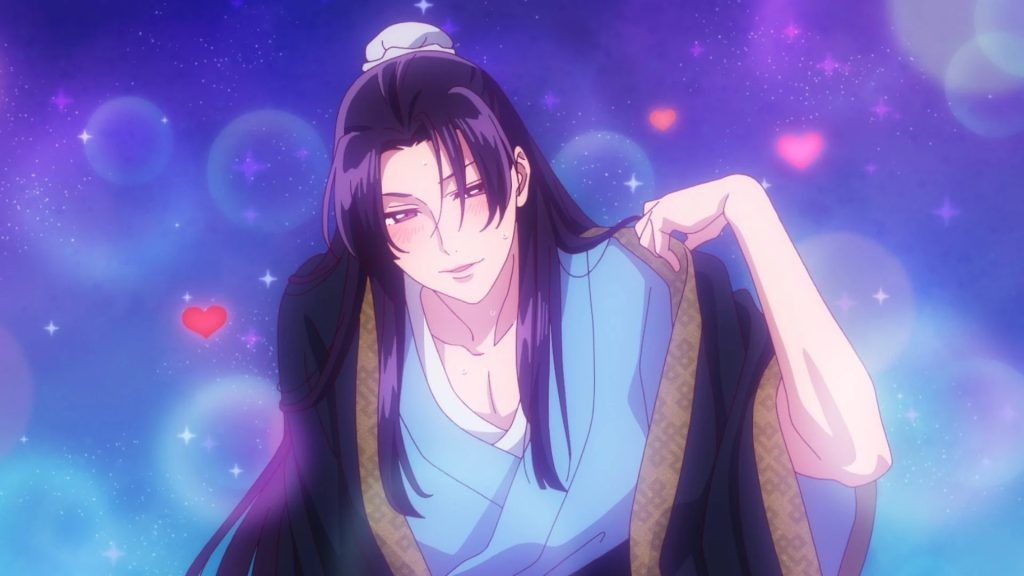
Bishie/Bishounen
Short for bishounen, translated roughly as “pretty boy.” Used for attractive male anime characters, and sometimes for real-life. Generally, they’re sort of girlish-looking with delicate features.
Jinshi from The Apothecary Diaries and Howl Jenkins Pendragon from Howl’s Moving Castle are classic examples.
Loli
Loli refers to Japanese media pertaining to the attraction of young-looking, cute girls that blend slightly erotic characteristics. The term comes from “Lolita complex.”
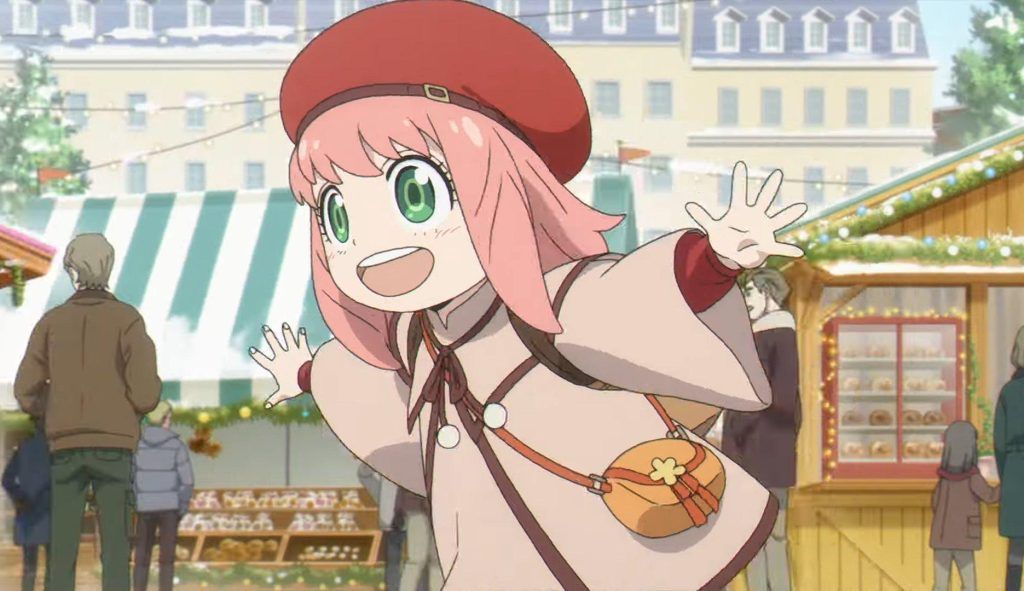
Anya Forger from Spy x Family wins hearts with her expressions and antics, and Victorique de Blous from Gosick is another tiny but incredibly clever loli.
Shota
The male equivalent of loli, referring to young-looking, cute boys in anime and manga. Derived from “Shotaro complex”, characters like Nishikata from Karakai Jōzu no Takagi-san and Aki Shiina from Sunohara-Sō no Kanrinin-san are good examples.
Moe
A term used to describe characters who are cute, endearing, or evoke a protective feeling from the audience.
For example, the adorable students in K-On! or Lucky Star are considered moe.
Chibi
Chibi is a Japanese slang word describing something short (a thing, an animal, or a person). In anime, it refers to cute, small, simplified character designs used for comedic effect.
For instance, the tiny, exaggerated versions of the characters in Attack on Titan: Junior High are chibi.
Kemonomimi
Characters with animal-like features, usually ears or tails, such as catgirls or foxboys.
Popular examples include Koneko from High School DxD and Holo from Spice and Wolf.
What did you think? Did you already know some or most of these words? Let us know your favorite words to use as an anime fan!
As always,
Keep Smiling!


